Building a new home involves hundreds of pivotal decisions—from choosing the right block and refining the floor plan to selecting high-grade materials, coordinating trades, and completing the final handover. Yet, of all these choices, none carries more weight than choosing the right residential builder before any soil is turned.
- Accreditation is not the same as legal registration: In Victoria, you must independently verify that your builder holds an active Domestic Builder - Unlimited (DBU) license via the Building and Plumbing Commission (BPC).
- Important 2026 Insurance Reforms: From 1 July 2026, qualifying residential contracts over $20,000 are subject to Victoria’s updated Home Warranty scheme, which builders must secure upon signing.
- Beware the lowest quote: Builders who omit site costs, engineering, or realistic fixture allowances will hit you with devastating variations during construction.
- Site analysis comes first: A quality builder assesses your soil, fall of the land, orientation, and council overlays before finalizing structural drawings.
A builder may present a stunning website, polished display homes, or an eye-catching headline price, but those promotional elements tell you very little about whether they are legally registered, properly insured, experienced with your specific site constraints, or equipped to manage your project smoothly from council submission to keys in hand.
What Is an Accredited Residential Builder?
Homeowners frequently use the term "accredited residential builder" when looking for a certified, reliable, and professional construction company. However, in the Australian building industry—and particularly in Victoria—industry accreditation and statutory legal registration are not the same thing.
Voluntary Memberships
Refers to voluntary membership in industry associations (such as Master Builders Association or HIA) or private quality marks. While memberships signal professional standing, they do not grant legal permission to build homes in Victoria.
Mandatory Legal Licence
Mandated under the Victorian Building Act 1993 and regulated by the Building and Plumbing Commission (BPC). A builder must hold active registration to carry out domestic building work valued over $10,000 or enter into major domestic contracts.
The BPC recognizes specific domestic building practitioner classes. The most comprehensive is Domestic Builder - Unlimited (DBU), which authorizes the builder to manage, coordinate, and arrange all aspects of domestic building work (subject to any individual conditions). Other classes include Domestic Builder - Limited (DBL), restricted to specific specialized trades such as framing, foundations, or waterproofing.
"Rather than merely asking, 'Is this builder accredited?', every homeowner should ask: 'Is this builder properly registered with the Building and Plumbing Commission for the exact type of build I am doing, and can I verify their licence and insurance status independently?'"
Why Choosing the Right Residential Builder Matters
A residential builder is far more than a manager of timber, concrete, and brickwork. The builder serves as the project director coordinating architects, structural engineers, soil testers, trade contractors, material suppliers, local council planners, and private building surveyors.
The Building and Plumbing Commission warns Victorian homeowners that engaging an unregistered builder leaves them with limited legal recourse and forfeits access to domestic building insurance protections.
Accurate Scope of Work
Detailed documentation prevents misaligned expectations and budget shortfalls.
Regulatory Compliance
Strict adherence to the National Construction Code (NCC) and Victorian building regulations.
Transparent Variations
Written change procedures so costs are approved before any work begins on-site.
Structured Communication
Regular site updates, direct access to the builder, and prompt issue resolution.
Consumer Safeguards
Access to statutory dispute resolution and Victorian Home Warranty coverage.
Architectural Integrity
Faithfully translating bespoke sketches and structural calculations into lasting quality.
For custom homes, these safeguards become doubly vital. Unlike repetitive volume estates, a custom architectural home requires bespoke structural engineering, customized joinery, specialized materials, and rigorous on-site supervision.
1. Check the Builder's Registration
The first practical step in vetting any residential builder in Victoria is confirming their registration status independently. Never rely solely on verbal assurances, business cards, email signatures, or logos printed on sales literature.
The Building and Plumbing Commission provides a free public practitioner register. You can search by practitioner surname, registered business name, or registration number (such as CDB-U or DB-U).
| What to Verify | Why It Matters to You | How to Confirm |
|---|---|---|
| Registration Status | Confirms whether the license is currently active, suspended, or lapsed. | BPC Public Register |
| Registration Class | Verifies whether they hold Domestic Builder - Unlimited (DBU) or a limited trade class. | Practitioner Card |
| Conditions & Limitations | Reveals if regulatory restrictions have been placed on their building scope. | BPC Register Details |
| Legal Business Details | Ensures the entity named in your contract matches the registered legal entity. | ABN Lookup & Contract |
| Disciplinary Record | Shows any past disciplinary findings, VCAT determinations, or fines. | BPC & CAV Registers |
| Insurance Compliance | Validates statutory eligibility to take out mandatory Victorian Home Warranty cover. | VMIA / Scheme Portal |
Confirms whether the license is currently active, suspended, or lapsed.
Verifies whether they hold Domestic Builder - Unlimited (DBU) or a limited trade class.
Reveals if regulatory restrictions have been placed on their building scope.
Ensures the entity named in your contract matches the registered legal entity.
Shows any past disciplinary findings, VCAT determinations, or fines.
Validates statutory eligibility to take out mandatory Victorian Home Warranty cover.
2. Look Beyond the Word "Accredited"
The word "accredited" sounds reassuring in sales brochures and digital advertisements, but it is no replacement for thorough verification. A builder claiming accreditation might merely hold paid membership in a regional industry club.
Consumer Affairs Victoria (CAV) advises all prospective home builders to investigate the complete corporate and commercial identity of the builder. Never sign an agreement that only identifies a trading name or casual first name.
What CAV Recommends You Confirm:
- The registered legal company name, Australian Business Number (ABN), and Australian Company Number (ACN).
- The individual registered building practitioner who is legally responsible for the site supervision and construction works.
- Proof of valid Public Liability insurance policy currency (minimum $5M–$10M).
- Confirmation that the trading address is a genuine permanent commercial office, not merely a transient post office box.
3. Check the Builder's Experience With Your Type of Home
Not every licensed residential builder is equipped for every type of residential project. The Australian building landscape is segmented into distinct specialties:
Project-Home Catalogs
Focus on repetitive mass-market plans built on flat greenfield blocks. They struggle with custom alterations, sloping blocks, or non-standard luxury finishes.
Extensions & Restorations
Excel at retrofitting older timber or brick structures, but may lack the engineering infrastructure for complete turnkey new builds.
Bespoke Architectural Builds
Specialists like Jayson Constructions who design and build bespoke homes around your block contours, solar orientation, family lifestyle, and premium materials.
Ask to See Homes Similar to Your Design
Don't just ask to see the builder's single most luxurious flagship residence. If you intend to build a contemporary family two-storey home on a sloping parcel in Clyde North, ask to inspect previous projects built on sloping terrain with comparable square meterage and detailing.
4. Review the Builder's Portfolio Carefully
A comprehensive portfolio reveals far more than pretty photography. It demonstrates the builder's consistency across multiple seasons and design complexities.
Key Quality Markers to Look For:
5. Understand Exactly What Is Included in the Quote
The lowest initial quote is almost never the lowest final cost. In the residential construction industry, aggressive builders frequently omit crucial site preparation, engineer footings, or essential finishes to make their quote appear artificially competitive.
The Danger of Vague PC and PS Items
Two common clauses in building quotes can dramatically inflate your final budget:
Allowances for supply-only items (taps, tiles, appliances). If the builder quotes a $500 appliance allowance and you choose a $2,500 oven, you pay the difference plus builder margin.
Estimates for work where costs cannot be finalized beforehand (site cut, rock excavation, retaining walls). Unscrupulous builders underestimate these numbers to secure contracts.
Essential Line Items to Clarify Before Comparing:
6. Read the Building Contract Before You Sign
The Major Domestic Building Contract is the legally binding instrument that governs your entire build. In Victoria, any domestic building work exceeding $10,000 must be formalized with a standard contract compliant with the Domestic Building Contracts Act 1995.
Consumer Affairs Victoria Checklist for Contracts:
- Statutory Cooling-Off Period: Victorian law provides a 5-business-day cooling-off period after signing a major domestic building contract.
- Maximum Deposit Limits: If the contract price is less than $20,000, the maximum deposit is 10%. For contracts of $20,000 or more, the maximum deposit permitted by law is 5%.
- Standard Progress Stages: Progress claims should align with the legislated stages: Base stage, Frame stage, Lock-up stage, Fixing stage, and Final Completion / Handover.
- Independent Legal Review: We strongly advise homeowners to have an experienced building lawyer or contract specialist review all special conditions before signing.
Never Compare Builders on Price Alone
A difference of $30,000 or $50,000 between two quotes often reflects what has been left out, not what has been saved. Always demand an itemized, side-by-side scope review to evaluate what you receive for your investment.
7. Verify Insurance and Victoria's 2026 Home Warranty Scheme
Insurance arrangements for Victorian residential construction underwent landmark legislative reforms. Every homeowner planning a build in 2026 and beyond must understand these regulatory protections.
Victoria's Updated Home Warranty Scheme
From 1 July 2026, eligible new domestic building work carried out under qualifying major domestic building contracts is governed by Victoria’s reformed Home Warranty scheme.
• Monetary Threshold: Mandatory for all residential building projects valued at over $20,000 on homes up to three storeys in height.
• Builder Obligation: The builder is legally required to take out the statutory Home Warranty policy immediately upon contract signing, before taking any deposit or commencing any site works.
• Certificate of Cover: You must receive an official Certificate / Notice of Cover confirming the property address, contract value, and builder details before paying your deposit.
In addition to statutory Home Warranty coverage, request a current Certificate of Currency for Public Liability Insurance (protecting against on-site injury or property damage to neighboring properties) and Contract Works Insurance (protecting against storm, fire, or theft while your home is under construction).
8. Understand the Builder's Design & Construction Process
A smooth building journey is built on structured project management. Reputable builders follow a clearly defined progression from initial concepts to final handover.
Initial Consultation
Discussion of lifestyle, vision, block characteristics, and realistic construction budgets.
Site Assessment
Comprehensive soil tests, contour surveys, service location checks, and orientation analysis.
Concept & Floor Plans
Architectural drafting tailored to solar paths, council setbacks, and family living routines.
Structural Engineering
Detailed footing, slab, and framing engineering computations for statutory approval.
Permits & Approvals
Managing City of Casey or local council planning permits and private building surveyor lodgement.
Contract & Inclusions
Review of major domestic building contract, schedule of finishes, and insurance cover.
Construction Phase
Slab pour, timber framing, lock-up brickwork, internal fixing, cabinetry, and painting.
Quality Inspections
Mandatory statutory surveyor inspections at base, frame, lockup, and pre-handover PCI.
Handover & Warranty
Occupancy permit issuance, key handover, maintenance warranty period, and ongoing support.
9. Consider the Building Site, Not Just the House Design
An experienced residential builder assesses your parcel of land just as meticulously as the architectural blueprint. Even within the same street in Melbourne’s south-east, two adjacent blocks can present entirely distinct engineering and construction challenges.
Critical Site Variables to Investigate:
• Slope and Topography
Fall across the building envelope dictates cut-and-fill depth, split-level foundations, or engineered retaining walls.
• Soil Reactivity (AS 2870)
Highly reactive clays (Class H1, H2, or E) or uncontrolled fill (Class P) require engineered waffle pod slabs or screw piers.
• Council Overlays & ResCode
City of Casey planning overlays, bushfire attack levels (BAL), stormwater detention requirements, and street setbacks.
• Easements & Underground Services
Sewer and stormwater easements dictate minimum structural clearances and footing depths.
10. Ask How Variations Are Managed
Even with the most meticulous planning, projects can evolve. You might decide to upgrade your tapware, add automated skylights, or modify joinery during the build. The crucial question is: How does your builder calculate, document, and bill for these changes?
Consumer Affairs Victoria Variation Requirements:
By law, variations must be documented in writing. The variation notice must describe the work, explain why it is needed, specify any time extensions required, and state the exact financial adjustment. A builder cannot demand payment for a variation until the work is completed, and should never begin non-urgent variation works without your prior written sign-off.
11. Look at Communication and Project Management
Building a residential property is a multi-month journey. Transparent, regular communication is the foundation of a low-stress construction experience.
Do you have direct access to the builder or site supervisor, or are you routed through a remote call centre?
How often do you receive photo updates and schedule forecasts? (Weekly or fortnightly is standard practice.)
Can you inspect the build with your site supervisor at key milestones (pre-pour, pre-plaster, lock-up)?
How are unexpected engineering or supplier delays logged, escalated, and resolved?
12. Research the Builder's Reputation & Compliance History
Online customer reviews offer helpful clues, but they should never be your sole benchmark. Look for consistent patterns rather than isolated outliers.
Key Reputation Aspects to Investigate:
Choosing a Residential Builder in Melbourne and Victoria
For homeowners in Melbourne’s rapidly expanding south-east—including Clyde North, Cranbourne, Berwick, Officer, and Pakenham—choosing a local builder ensures in-depth knowledge of City of Casey planning controls, local geotechnical conditions, and neighborhood guidelines.
Jayson Constructions – Clyde North Custom Specialists
Based at 8 Denali Drive, Clyde North, Jayson Constructions is a licensed custom home builder delivering bespoke architectural homes, single and double-storey residences, knockdown rebuilds, and dual occupancy developments across south-east Melbourne.
12 Questions to Ask an Accredited Residential Builder
Before committing to any builder, print or save this interview questionnaire to evaluate their transparency, systems, and professionalism during your initial consultation:
Accredited Residential Builder Checklist
Use this comprehensive 10-point checklist to transition your decision away from marketing slogans and toward verifiable facts:
| Check Area | What to Confirm | Verification Status |
|---|---|---|
| 1. Registration | Active registration with the Victorian BPC (e.g. DBU license). | Mandatory |
| 2. Scope | Builder is authorized for the full scope of your intended residential project. | Mandatory |
| 3. Insurance | Victorian Home Warranty Cover for >$20,000 + Public Liability >$5M. | Mandatory |
| 4. Portfolio | Completed homes matching your architectural complexity and finish level. | Essential |
| 5. Quote Inclusions | Transparent line-item inclusions, realistic site costs, and clear PC/PS sums. | Essential |
| 6. Building Contract | Compliant Major Domestic Building Contract reviewed by independent legal counsel. | Recommended |
| 7. Variations Policy | Clear written variation procedure with upfront pricing and schedule updates. | Essential |
| 8. Communication | Named site supervisor, agreed milestone walk schedule, and reporting cadence. | Essential |
| 9. Compliance History | Verified reviews, clean CAV disciplinary record, and positive client references. | Essential |
| 10. Site Understanding | Detailed site analysis taking into account soil test, slope, setbacks, and council rules. | Mandatory |
Active registration with the Victorian BPC (e.g. DBU license).
Builder is authorized for the full scope of your intended residential project.
Victorian Home Warranty Cover for >$20,000 + Public Liability >$5M.
Completed homes matching your architectural complexity and finish level.
Transparent line-item inclusions, realistic site costs, and clear PC/PS sums.
Compliant Major Domestic Building Contract reviewed by independent legal counsel.
Clear written variation procedure with upfront pricing and schedule updates.
Named site supervisor, agreed milestone walk schedule, and reporting cadence.
Verified reviews, clean CAV disciplinary record, and positive client references.
Detailed site analysis taking into account soil test, slope, setbacks, and council rules.
Frequently Asked Questions
Clear, factual answers to the most common questions Australian homeowners have when evaluating registered residential builders:
Look for a builder who is properly registered with the relevant statutory authority (such as the Building and Plumbing Commission in Victoria), holds appropriate insurance coverage, has demonstrable experience with your specific home type, provides clear itemised quotes without hidden allowances, operates under a transparent standard building contract, and provides a structured construction management and communication process.
Final Thoughts
When choosing an accredited residential builder in Australia, look past display home styling and aggressive headline marketing. Begin with the non-negotiable fundamentals: confirm statutory registration with the Building and Plumbing Commission, verify 2026 Victorian Home Warranty insurance arrangements, review past builds, and compare quotes on an itemized, apples-to-apples basis.
Once those regulatory baselines are secure, focus on the factors that determine your day-to-day experience: site responsiveness, craftsmanship, clear variation pricing, and honest communication.
Discuss Your Custom Home with Jayson Constructions
Planning to build in Clyde North, Cranbourne, Berwick, or south-east Melbourne? Meet directly with our licensed master building team to review your site, discuss floor plans, and build with total clarity.
Related Residential Guides
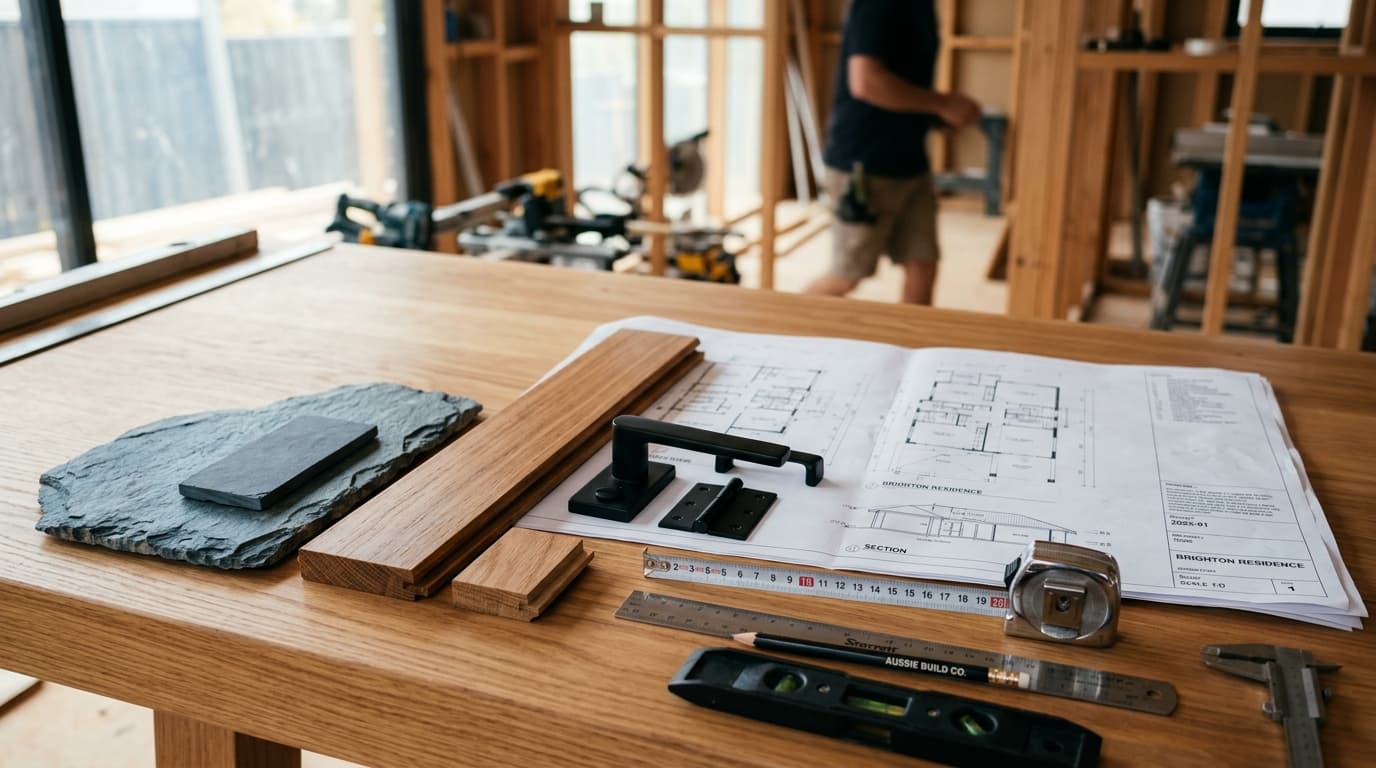
How to Select Materials for a Luxury Home Build: Timber, Stone & Glass Compared
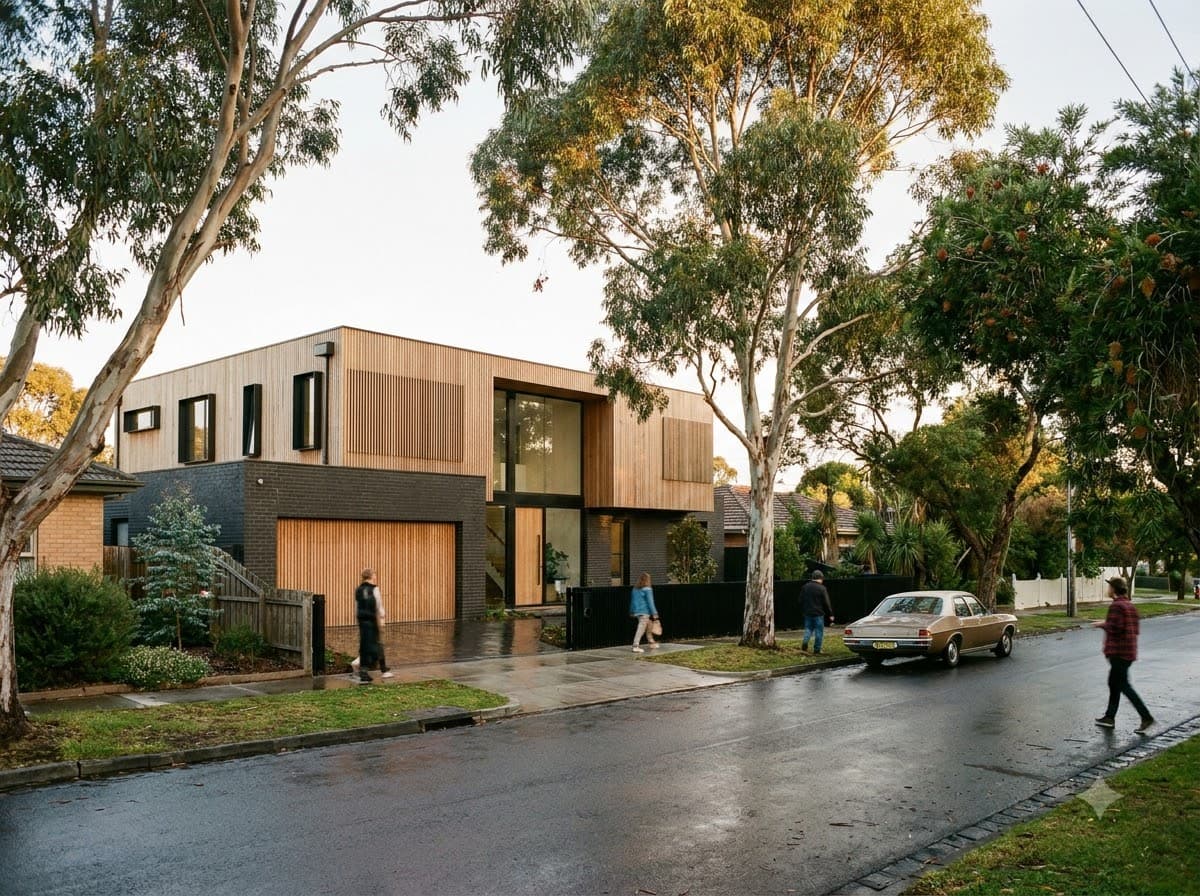
Renovate or Rebuild? A Melbourne Homeowner's Decision Guide